In a Nutshell: Stocks and commodities cooled off in June, as the only risk asset to appreciate was real estate. Interest rates look like they have topped out, indicating that peak inflation may be behind us.
Domestic Equity: Cooling Off
The U.S. stock market put up its first red month since March, but finished the first half of the year up about 9.5%. That’s a great start to the year, but with it came some high volatility moments. Looking into the back half of 2026, our economic forecasting is suggesting that the third quarter (particularly early in the quarter) may show some economic cooling, which could provide headwinds to the stock market. Once we traverse this cooling period, we expect a strong finish to the year. You can see from the price action below that the stock market has already started cooling off as we begin the third quarter. Most of the volume from the second quarter traded in the blue box, where stocks are consolidating, so if the price area contained by the blue box fails, we could see a pullback into the 7100 area.

Our sentiment indicator continues to show lower numbers than we’d expect given the price thrust we saw in the second quarter. Although the sentiment score is overall positive, it’s not as strong as we’d like to see.

Our participation metric is also holding up well and staying in the positive side of the chart, but it hasn’t hit the red line since the beginning of June. Given the holding pattern in price, sentiment and participation, the stock market may need to go down to go up.

Global Equity: Down, But Not Out
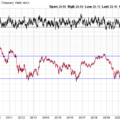
The global equity markets slowed in the month of June, closing out a strong first half of the year. In the chart below, you can see the green box is still holding strong. Across the globe we are expecting (in aggregate) a slowing global economy with persistent inflation. While not an ideal backdrop, it could be enough to keep global stock prices afloat until what appears to be a stronger economic result in the fourth quarter this year.

Real Estate: Holding Up Well
Real Estate was up 2% in June – but it was one of the few investments that went up for the month. Interest rates rolling over and falling was the big catalyst for real estate. Interest rates falling, and real estate catching a bid is in alignment with our economic expectation of slowing U.S. GDP in the third quarter. The combination of slowing growth and falling rates tends to attract investors to real estate as a safety position. Because of real estate’s bond-like properties, investors tend to hide out in real estate when the economy slows. Given the positive potential for real estate, we are at the bottom of a range for interest rates, so rates will likely need to fall further to boost real estate prices. This process may take time to play out and may not work on the first attempt, so we’ll need to monitor this position closely.

Commodities: Is Inflation in the Past?
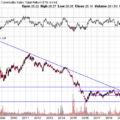
Commodities fell precipitously in June. After starting to roll over in May, we saw a few areas of support that could keep the broad basket of goods afloat. Led by falling oil prices and perceived stability in the Middle East, commodities fell like a hot knife through butter at the red support levels below. What does this all mean? Given how fast oil has fallen, it is likely peak inflation expectations are behind us. Looking in our bond section below, you’ll see that interest rates peaked around the same time as commodities; commodities will be a difficult position to own with inflation falling, so we’ll monitor this space closely going forward.

Our gold top call in February looks like it has stuck as the yellow metal has not even sniffed the blue channel we highlighted last month. Gold is now down 30% from its peak and still has a lot of work to do in order to establish a new uptrend. This position is best left alone until a new, positive trend is established.

Fixed Income: Inflation Peaked?
The 10-year U.S. Treasury interest rate hit our red box in May and has been heading lower since. The 10-year rate spent most of June trending lower into our green “equilibrium” area, where stocks and bonds tend to be at peace with one another. While our macro data is suggesting the U.S. economy may have a slight slowdown, the big takeaway is that peak inflation is likely in the past. Looking at our commodities chart above and the 10-year rate chart below, we see they both peaked in mid May, also indicating peak inflation expectations have passed us by.

With peak inflation in the rearview mirror, the short-term rate cut/hike chart below is given more color and context. Currently, the market is positioned for a hike in short-term rates, based on past inflation numbers. However, with inflation likely slowing, that should give room for the Federal Reserve to take the more politically palatable path of keeping rates steady at 3.5-3.75%.

New Fed Chair Kevin Warsh kept rates steady at 3.5-3.75% in his first meeting and press conference as the Fed head. The most notable change with the Fed’s new leadership is that Warsh communicated the Fed will no longer play the role of forecaster. Prior Federal Reserve regimes would attempt to give “forward guidance” or forecasts based on their models. In theory, this will allow market forces to play out more naturally.
All Terrain Portfolio Update
The All Terrain Portfolio risk levels and positioning have been reduced slightly as we continue to see long-term trends stay intact, but with weakening short-term trends. In the second half of 2026, it looks like we’ll first see some economic cooling along with inflation falling, followed by a strong finish to the year. Navigating the near-term economic cooling will be our priority. We will use our forecasts as guides and utilize our data and indicators to execute the All Terrain Portfolio as intended.

Chart as of 6/30/26
Past performance is not indicative of future results. Other asset classes or investment vehicles may be used in client portfolios and client portfolios may not hold all positions of the model at the same time as the model. This chart and its representations are only for use in correlation to the proprietary timing model by Arkenstone Financial, Registered Investment Advisor. Actual client and All Terrain Portfolio(TM) positions may differ from this representation.

- Risk Is Rising - November 6, 2026
- Rising Rates Wreak Havoc - October 9, 2026
- Stocks Pause, Await the Fed - September 4, 2026

Leave a Reply